
EcoVadis Assessment Deadline Support: What to Do When Time Is Running Out

When your EcoVadis deadline is close and your submission isn't ready
It is one of the most common reasons companies reach out to me. The message usually arrives with a note of mild panic: the EcoVadis deadline is six weeks away, the submission is not where it needs to be, and the sustainability manager has run out of options.
If that describes your situation, the first thing you need to know is this: you are not alone, and you do have options. After over 200 EcoVadis assessments, I can tell you that the last-minute scramble is far more common than anyone talks about.
The second thing you need to know is that every option comes with trade-offs, and the right choice depends on your specific priorities, timeline and risk tolerance.
This article walks through the three realistic paths available to you when your EcoVadis deadline is approaching, what each one means in practice, and how to decide which is right for your organisation.
By the end, you will understand:
what a realistic timeline looks like from here to submission
the three paths you can take, and the honest trade-offs of each
how to choose the option that protects your score the most
how to avoid the same deadline pressure next year
How close is "close"? Assessing your real timeline
Before you can choose a path forward, you need to be honest about how much time you have and what state your evidence is in. These are the questions I ask in every initial conversation:
When is the actual deadline? Not the internal target, the deadline on the EcoVadis platform. This is the hard stop.
What state is your submission in? Do you have policies in place? Is there a KPI dashboard? Has anyone started filling in the questionnaire?
What is your target medal? A realistic plan for maintaining a Silver is very different from a plan that aims for Gold or Platinum.
Do you have internal capacity? Is there a sustainability manager or team who can commit meaningful hours over the coming weeks, or is EcoVadis one of many priorities competing for attention?
Once these questions are answered, the path forward usually becomes clear. Let us look at the three realistic options.
Option 1: Submit what you have and plan from the scorecard
This is the option most companies reach for by default, often without realising it is a strategic choice. You take what you have already prepared, upload it, and accept that the result will reflect the state of your submission rather than your full sustainability potential.
When this option makes sense:
the deadline is truly non-negotiable
internal capacity is genuinely limited in the coming weeks
you are prepared to accept a lower score in exchange for meeting the deadline
you want to use this cycle as a structured baseline rather than a peak performance
What happens next: Around six to eight weeks after submission, your scorecard arrives. This is where I come in for many clients. Together we go through the scorecard line by line, identify exactly where points were lost and why, and build a prioritised improvement plan that you can execute over the following twelve months. The beauty of this approach is that the scorecard itself becomes the most valuable strategic document you receive. It tells you precisely what EcoVadis expected, where the gaps were, and what to focus on next.
The honest trade-off: Your score will likely be lower than your sustainability work deserves. If you have a customer requirement tied to a specific medal level, this option may not be viable. However, for companies whose immediate priority is meeting the deadline and setting up a structured improvement cycle, this is often the most realistic path.
Option 2: Full-sprint submission support with an experienced consultant
The second option is to engage intensive expert support to produce the strongest possible submission within the time available. This is the path companies take when the deadline is fixed, the score matters, and the internal team is prepared to commit to a demanding six-week process.
When this option makes sense:
there is a customer requirement or business reason why the score this cycle matters
your internal team can commit significant hours over the next weeks
you are prepared for an intensive collaboration rather than a gentle process
you want expert guidance on what to prioritise and how to evidence it
What the process looks like: In six weeks, I can realistically take a company from a partially prepared state to a structured, credible EcoVadis submission. That involves rapid gap analysis, accelerated policy development, setting up or strengthening the KPI dashboard, and reviewing every piece of evidence before upload. It is intensive but feasible.
The honest trade-off: I want to be straight with you here. Even if I can move quickly on my side, the bottleneck is usually on the client side. New policies need internal review and sign-off. KPI data needs to be gathered from multiple departments. Evidence needs to be collected and validated. Six weeks is enough time for me to produce the work, but it is often not enough time for a company to absorb and implement the changes properly.
The result is almost always a stronger submission than Option 1. However, it is rarely as strong as what we could achieve together with a full six-month engagement starting earlier in the cycle. If you are going to take this path, go into it with realistic expectations.
Option 3: Extend your deadline on the EcoVadis platform
This is the option most companies do not know exists, or do not consider until someone suggests it. EcoVadis allows deadline extensions, typically for three months. That may sound like a smaller gain than the original six months you had, but it changes the calculation dramatically.
When this option makes sense:
your original deadline is close but the extension is still available
your score matters more than the original deadline
you can commit to a structured process over three months
your customer or stakeholder is willing to wait for a stronger result
What this gives you: Three months is enough time to run a proper gap analysis, develop tailored policies across all four EcoVadis themes, build or restructure a KPI dashboard, and review every piece of evidence before submission. It is not unlimited time, but it is genuinely workable. With the right structure and support, a three-month timeline can deliver a meaningfully better result than a six-week scramble.
The honest trade-off: Extending the deadline requires communication with your EcoVadis stakeholders, and sometimes with the customer or procurement team who is waiting for your score. Not every organisation feels comfortable asking for more time, even when it is the most strategically sound choice. But in my experience, three months of well-structured work almost always outperforms six weeks of emergency work, and the extension request is rarely the problem people fear it will be.
Which option is right for your company?
The right choice depends on three factors: how firm your deadline is, how much your score matters this cycle, and how much internal capacity you can commit.
If the deadline is immovable and internal capacity is limited, Option 1 is often the most honest choice. Meet the deadline, accept the result, and use the scorecard as your roadmap for next year.
If the deadline is immovable and the score matters, Option 2 is viable, but go into it with realistic expectations about what six weeks can deliver.
If the deadline has some flexibility and the score matters, Option 3 is almost always the best path. An extension is rarely as difficult to request as people fear, and the quality difference between a three-month process and a six-week sprint is significant.
How to avoid this situation next cycle
Deadline pressure is almost always a symptom of treating EcoVadis as an annual event rather than a continuous process. The companies I work with who consistently achieve Gold or Platinum are not the ones with the biggest sustainability budgets. They are the ones who treat EcoVadis as part of their regular management cycle.
Start your preparation six months before the deadline. Not one month, not three. Six. This gives you time to identify gaps, develop policies, collect data properly and review evidence without panic.
Build a KPI dashboard you update quarterly. When submission time comes, the data is already there. You are curating, not collecting.
Review your policies annually. A policy with a current review date scores better than one last touched three years ago, even if the content is identical.
Keep your evidence folder organised throughout the year. Every time a new training is delivered, an audit is completed or a certification is renewed, file it properly in your EcoVadis folder. Future you will be grateful.
How Kemi can help when your EcoVadis deadline is close
If your deadline is approaching and you are not sure which option is right for you, the best first step is a conversation. I offer a free 15-minute call specifically for companies in this situation. Together we will look at your timeline, your current state of preparation, and your priorities. Then I will give you an honest recommendation about which path makes the most sense, including whether you should be working with me or not.
If the path forward involves my support, I offer two routes. For companies under significant deadline pressure who need hands-on guidance through the submission, my 1:1 EcoVadis submission support covers everything from gap analysis to final review.
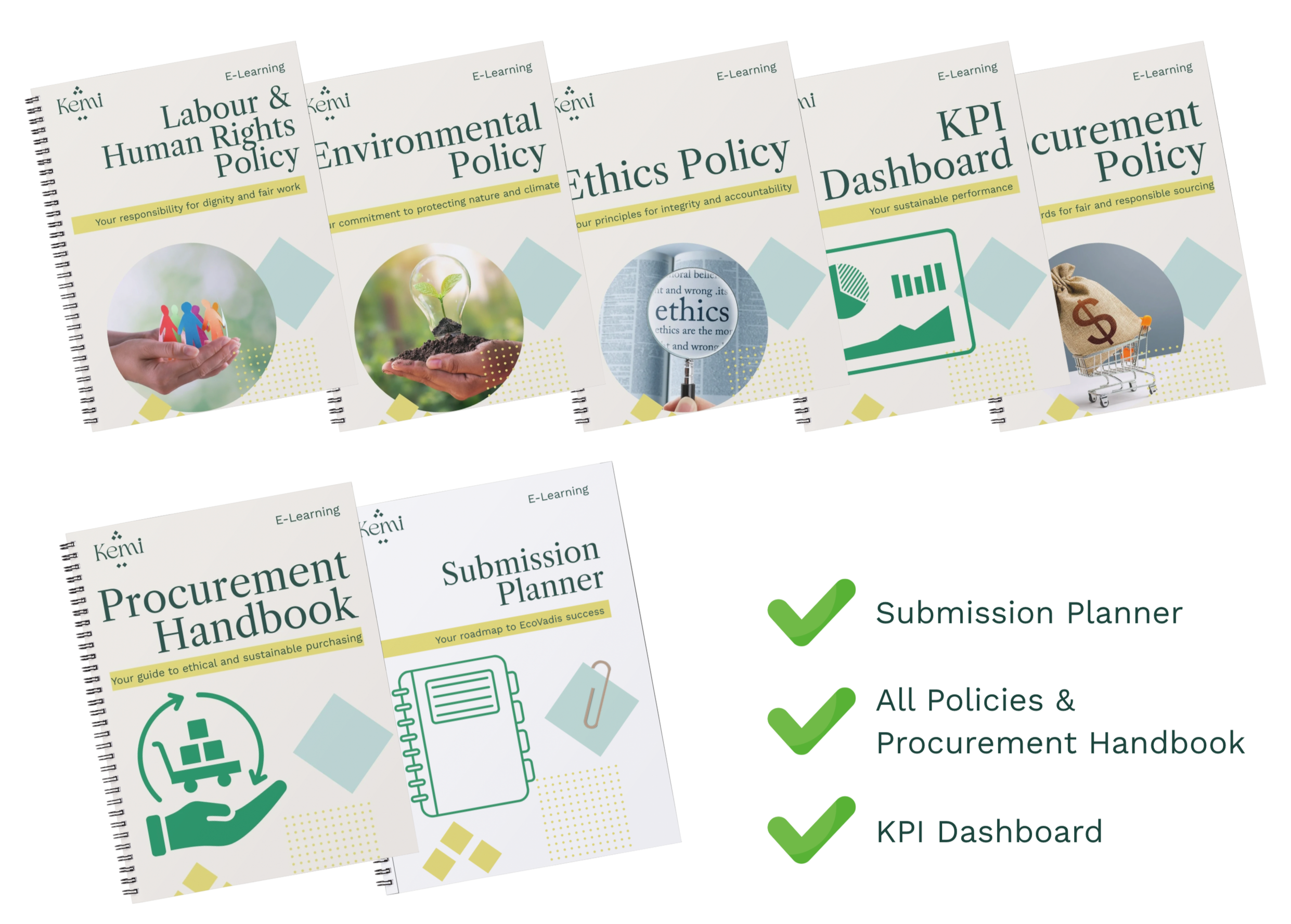
For companies who want expert resources but prefer to drive the process internally, my EcoVadis Templates package provides submission-ready policies, a KPI dashboard, a Procurement Handbook and a Submission Planner.
FAQ | EcoVadis Deadline
How close to the EcoVadis deadline can I still get professional support? I have started engagements as close as four weeks before a deadline. It is not ideal, but it is possible if the client has meaningful internal capacity to commit. The closer to the deadline, the more the quality of the final submission depends on how quickly you can produce policies, KPI data and evidence on your side.
Can I extend my EcoVadis deadline? Yes, in most cases. EcoVadis typically grants deadline extensions which can be requested through the platform. The process is straightforward, and the extension is almost always a better strategic choice than rushing a submission that will underperform.
What happens if I miss my EcoVadis deadline entirely? Your previous scorecard expires and your active questionnaire will be closed (it can be reopened though). This can create procurement and commercial issues, especially if customers are actively using your EcoVadis score in their supplier decisions. Extending the deadline before it expires is always preferable to missing it.
Is it worth submitting a weak assessment just to meet the deadline? In some cases, yes. If the alternative is no active rating at all, a weaker submission that maintains your presence on the platform is often the better choice. The scorecard then becomes your improvement roadmap for the following cycle.
How long does a properly prepared EcoVadis submission actually take? For companies submitting for the first time or aiming for a significant score improvement, I recommend six months of structured preparation. For companies with mature systems who are maintaining a strong score, three months is usually sufficient.
What does a typical EcoVadis deadline rescue project look like? It depends on timeline and current state. At six weeks out, I focus on rapid gap analysis, policy development, KPI dashboard setup and final evidence review. At three months out with an extension, I can run a full structured engagement from gap analysis to final submission. The key is realistic scoping based on what is actually possible in the time available.