
Policy vs Procedure: The EcoVadis Mistake That Takes 5 Minutes to Fix

The small mistake that costs companies EcoVadis points every cycle
One of the most common mistakes I see in EcoVadis submissions is also one of the easiest to fix. Companies upload a policy as evidence for a measures question, or a procedure as evidence for a policy question. EcoVadis rejects both, and points are lost without anyone quite understanding why.
The reason is simple. A policy and a procedure are two fundamentally different things in the EcoVadis framework. They answer different questions, they serve different purposes in the assessment, and they are scored in different places. When you upload one where the other is expected, you are not just losing a few points. You are signalling to the assessor that your management system is not clearly structured, and that perception affects how the rest of your submission is evaluated.
After more than 200 assessments, I can spot this confusion within minutes of opening a submission. The good news is that once you understand the distinction, fixing it is often a matter of relabelling documents, splitting combined files, or moving existing content to the right section of the questionnaire. It is genuinely one of the fastest wins available.
By the end of this article, you will understand:
what makes a policy different from a procedure in the EcoVadis framework
why mixing them up costs points even when the underlying work is strong
how to identify which of your existing documents belong in which category
how to restructure your submission so every document scores where it is supposed to
Why EcoVadis distinguishes between policies and procedures
EcoVadis does not evaluate your sustainability management system as a single block. It looks at three dimensions across every theme: Policies, Actions, and Results.
Policies capture your formal commitments. They state what your organisation stands for, what it will and will not tolerate, and who is responsible for ensuring those commitments are kept.
Actions describe how those commitments are brought to life in practice. They include training programmes, audit schedules, operational procedures, supplier engagement activities, and the concrete steps your organisation takes to implement policy commitments.
Results are the measurable outcomes of those actions, typically evidenced through KPIs and reporting.
Each dimension is scored separately. A strong policy does not compensate for weak actions, and strong actions do not compensate for a vague policy. The system is deliberately structured this way because EcoVadis wants to see a coherent management chain from commitment to implementation to measurable impact.
This is why uploading a policy document as evidence for a measures question does not work. The assessor is not looking at your file and deciding whether it is "good sustainability content". They are checking whether it answers the specific question being asked. A policy answers the question "what do you commit to?" A procedure answers the question "how do you do it?" These are different questions, and the same document can rarely answer both at the required level of detail.
What is a policy,
exactly?
A policy is a formal statement of commitment. It defines your organisation's position on a topic and sets out the expectations, responsibilities and principles that flow from that position.
A strong EcoVadis policy typically includes five elements:
Scope. Who does this policy apply to? All employees, all subsidiaries, all regions? A policy with unclear scope is harder to evaluate, and the assessor will default to a conservative interpretation.
Responsibilities. Who owns implementation? Who monitors compliance? Who reports? Policies without named responsibilities signal that the commitment is not actively managed.
Measurable commitments. "We aim to reduce emissions" is weaker than "we commit to reducing Scope 1 and 2 emissions by 30 percent by 2030". Specific, time-bound commitments score better.
References to concrete measures. A policy that mentions the programmes, audits or processes that support it shows that the commitment is connected to action.
A review mechanism. A policy that is reviewed annually or on a defined cycle signals an actively managed system. A policy last reviewed in 2019 signals the opposite.
Policies are uploaded in the Policies section of the EcoVadis questionnaire and are evaluated against the Policies scoring dimension.
What is a procedure, exactly?
A procedure is a practical instruction. It describes how a specific process is carried out in your organisation, often step by step.
Procedures include documents like:
training curricula and schedules
audit protocols and frequency
incident reporting and escalation workflows
supplier onboarding processes
whistleblowing procedures
waste management instructions
supplier code of conduct monitoring processes
A good procedure is operational rather than aspirational. It is the document someone refers to when they need to know what to do, not what the organisation stands for.
Procedures are uploaded in the Actions or Measures section of the EcoVadis questionnaire and are evaluated against the Actions scoring dimension.
The mistake that costs points, in practice
Here is how the confusion typically plays out in a real submission.
A company has an Environmental Policy that mentions, in passing, that the organisation provides environmental training to employees. When the company reaches the questionnaire section asking for evidence of environmental training, someone uploads the Environmental Policy, assuming the mention of training is enough.
It is not. The assessor is looking for evidence of the actual training programme: the curriculum, the schedule, the target audience, the attendance records, the topics covered. The policy only confirms that training exists in principle. It does not evidence that training happens in practice.
The result is predictable. The policy question is answered, and the policy scores. But the measures question is not answered with appropriate evidence, and the score for that question is significantly lower than it could have been. A procedure document, even a brief one summarising the training programme, would have scored meaningfully better in that slot.
This pattern repeats across all four EcoVadis themes. Procurement policies uploaded where supplier audit procedures were needed. Code of conduct documents uploaded where anti-corruption training evidence was expected.
The fastest way to check your own submission
If you want to quickly identify whether this mistake is costing your company points, here is a practical approach.
Step 1: Open your current EcoVadis submission and list every document you have uploaded.
Step 2: For each document, ask two questions.
Does it state what your organisation commits to? Does it describe how your organisation actually does something?
If the answer to the first question is yes, it is a policy. It belongs in the Policies section.
If the answer to the second question is yes, it is a procedure. It belongs in the Actions or Measures section.
If the document tries to do both, it is probably underperforming in both sections. Consider splitting it.
Step 3: Check where each document is currently uploaded.
If any documents are in the wrong section, that is your fastest route to recovering lost points. Moving them takes minutes and can meaningfully change your score on the next assessment.
Why this is one of the highest-return fixes available
Most EcoVadis improvements require real work: developing new policies, collecting new data, implementing new measures. This one does not. In many cases, the documents your company needs already exist. They are just in the wrong place.
That makes policy and procedure alignment one of the highest-return fixes available. A few hours of review, some relabelling, occasionally some splitting, and a meaningful portion of points that were being lost is recovered. I have seen companies gain several points across multiple themes simply by mapping their existing documents correctly.
If you have never done this review on your own submission, it is worth doing before your next cycle.
How Kemi can help
I offer two paths for companies who want to structure their evidence correctly.
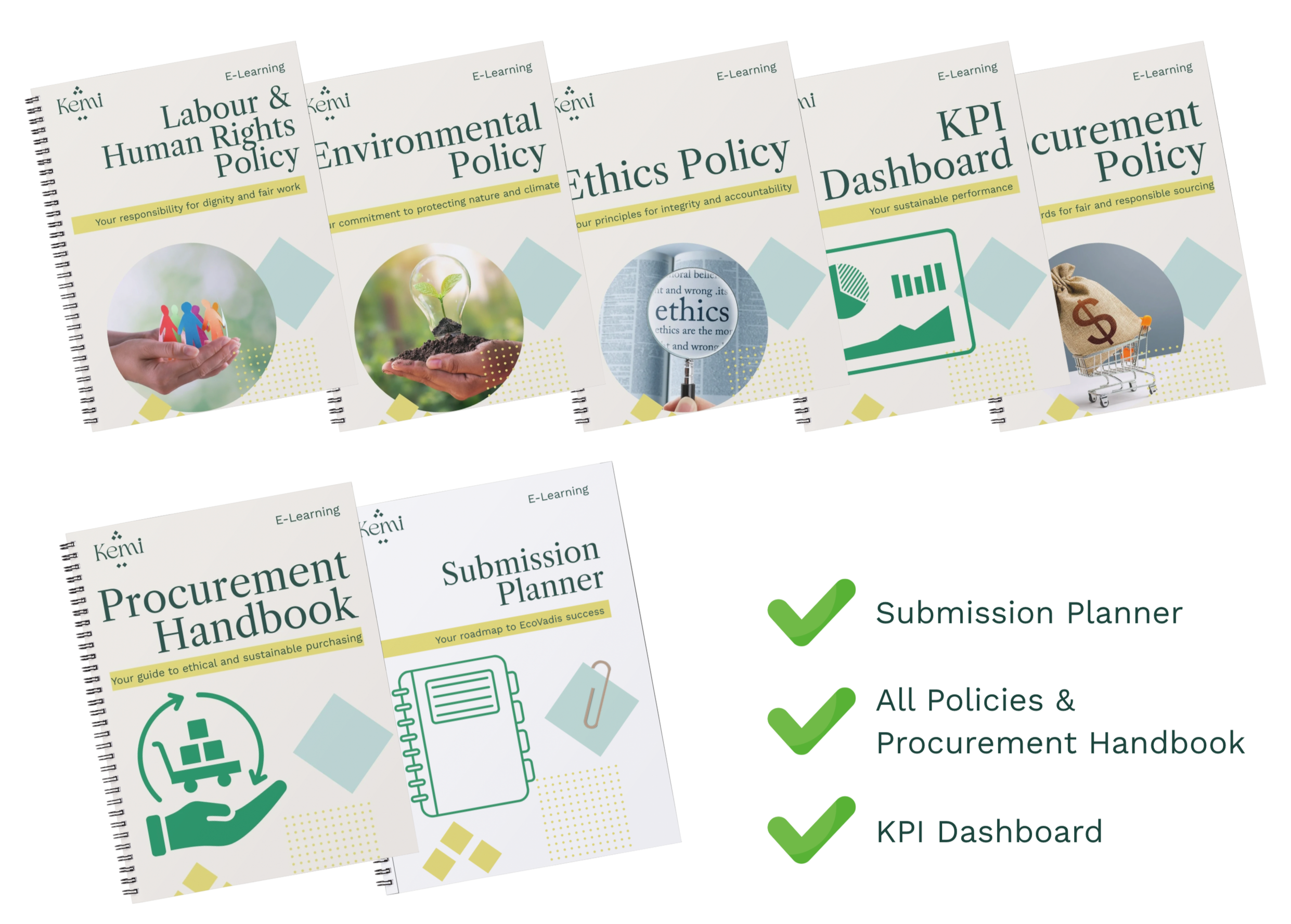
EcoVadis Templates. The Templates package includes professionally developed policy templates for all four EcoVadis themes, plus procedural documents like a Procurement Handbook. Each template is designed to do its specific job thoroughly, without the overlap that causes scoring confusion.
1:1 EcoVadis submission support. Direct expert guidance on structuring your evidence correctly across the full questionnaire. I help you map existing documents to the right sections, identify where splits are needed, and ensure every document scores where it is supposed to.
FAQ | Policy vs. Procedure
What is the difference between a policy and a procedure for EcoVadis? A policy is a formal statement of commitment that defines what your organisation stands for, including scope, responsibilities and measurable commitments. A procedure is an operational instruction that describes how a specific process is carried out in practice. EcoVadis scores them in different sections and evaluates them against different criteria.
Can one document be both a policy and a procedure? Technically yes, but in practice it usually underperforms in both categories. A combined document tends to be too detailed to be a clean policy and too principled to be a clean procedure. The stronger approach is to have a short, formal policy and a separate procedure or handbook that documents the operational detail.
Where does a Supplier Code of Conduct belong? A Supplier Code of Conduct is typically used as evidence for a measure question although it states commitments and expectations.
What happens if I upload the wrong type of document? EcoVadis does not reject the document outright, but it scores it based on what is expected in that section. A policy uploaded as measures evidence will not score as measures evidence, because it does not describe how something is done. The result is lost points for that question, even though the document itself may be strong.
How do I know which section my document belongs in? Ask yourself: does this document state what my organisation commits to (policy), or does it describe how my organisation actually does something (procedure)? If it clearly does one, upload it in the matching section. If it does both, consider splitting it into two documents.
Is this really one of the most common mistakes? Yes. In my experience across more than 200 assessments, confusion between policies and procedures is one of the most consistent patterns I see, especially in submissions where a well-intentioned team tried to reuse strong internal documents without understanding how EcoVadis categorises them.