
How Many Documents Do You Actually Need for Your EcoVadis Submission?

Fundamentals
EcoVadis Documents
If you're struggling with the 55 document limit EcoVadis prescribes, your system probably isn't mature.
After supporting over 200 EcoVadis assessments, I can tell you: the opposite is true. The companies with the highest scores almost always submit fewer documents than the companies stuck at Bronze or Silver.
The reason comes down to one word: structure.
By the end of this article, you'll understand:
why hitting the 55 document limit often lowers your score instead of raising it
what EcoVadis actually evaluates (and what it ignores)
how a 15 document submission outperforms a 55 document one
how to build an evidence library where every file earns its place
In 60 seconds: the evidence model
A strong EcoVadis submission is built on four elements, not on volume:
Policy A formal commitment that is specific to your organisation, covers the relevant risks and defines clear responsibilities.
Measures Concrete actions that bring the policy to life: training programmes, audits, reduction initiatives, supplier engagement.
KPIs Quantifiable indicators that track the impact of your measures over time, structured around what EcoVadis actually assesses.
Coverage Evidence that your policies, measures and KPIs apply across your entire organisation, not just one site or business unit.
When these four elements are aligned, you often don't need more than 15 to 20 well chosen documents. Each document serves a clear purpose. Each one maps directly to the assessment criteria. And the assessor can follow the thread from commitment to action to result without guessing.
Why uploading more documents doesn't improve your EcoVadis score
I regularly see companies struggling with the 55 document limit EcoVadis prescribes. They want to attach everything they can find: certificates, training records, meeting minutes, screenshots, internal emails, sustainability reports, brochures. They often tell me they wish they could upload more.
The logic is understandable. If I give them everything, they'll find what they need.
But EcoVadis assessors don't work that way. They have a limited amount of time per submission, and they evaluate your evidence against a very specific framework. When they open a submission and find 55 documents with no clear structure, two things happen.
The logic is understandable. If I give them everything, they'll find what they need.
But EcoVadis assessors don't work that way. They have a limited amount of time per submission, and they evaluate your evidence against a very specific framework. When they open a submission and find 70 documents with no clear structure, two things happen.
First, it becomes harder for the assessor to find the evidence that actually matters. A strong policy buried between 15 loosely related attachments can easily be overlooked or undervalued.
Second, a large volume of documents often signals that the company itself doesn't know which evidence is most relevant. That is a sign of limited system maturity, not strength.
What good looks like: Every document in the submission can answer this question: "Which policy, measure, KPI or coverage gap does this file close?" If you can't answer that clearly, the document probably doesn't belong.
The 15 document submission that outperforms the 55 document one
Let me give you a practical example. I've worked with companies that submitted around 15 documents and achieved Gold or Platinum. Their evidence library typically looked something like this:
Policies (4 documents) One clear, tailored policy per EcoVadis theme: Environment, Labour & Human Rights, Ethics, Sustainable Procurement.
KPI Dashboard (1 document) A structured dashboard covering all four themes in a single file. No scattered spreadsheets. One source of truth.
Procurement Handbook (1 document) A ready made framework documenting sustainable sourcing practices, supplier expectations and procurement policies.
Evidence of concrete measures (5 to 7 documents) Training records, audit summaries, certifications, action plans. Each one mapped to a specific question or theme.
Sustainability report (1 to 2 documents) A well structured sustainability report that ties everything together, presents quantitative targets and shows progress over time.
Employee Handbook (1 document) A comprehensive handbook covering working conditions, code of conduct, training approach and employee rights. One document that evidences multiple Labour & Human Rights criteria at once.
That is around 15 documents. Every single one is relevant. Every single one maps to the scoring framework. The assessor can review the submission efficiently, find what they need, and score accordingly.
Compare that with a submission of 55 documents where policies are vague, KPIs are scattered across multiple spreadsheets, and the assessor has to piece together the story from dozens of loosely connected files. The sustainability work behind both submissions might be similar. But the score will not be.
Why companies over upload: three common patterns
In my experience, excessive document uploads usually come from one of three places.
Uncertainty about what EcoVadis expects
When teams don't fully understand the methodology, the instinct is to provide everything and let the assessor decide what's relevant. This puts the burden of interpretation on EcoVadis rather than on the company. EcoVadis will not do that work for you.
Compensating for weak policies with supporting evidence
If your Environmental Policy is generic and could belong to any company in any industry, adding 10 supplementary documents won't fix that. EcoVadis will still score the policy as weak. No amount of attachments compensates for a policy that lacks specificity, clear responsibilities and measurable commitments.
No structured evidence strategy
Many companies treat the EcoVadis submission as a document collection exercise rather than a strategic process. They gather what they have, upload it, and hope for the best. Without a clear mapping of evidence to assessment criteria, the result is volume without purpose.
If you're staring at your evidence folder wondering what's actually needed and what's overkill, that's exactly where I usually come in. Have a look at my 1:1 EcoVadis submission support.
How to reduce your document count and increase your score
The goal isn't to upload as little as possible. The goal is to make every document count.
Start with the framework, not with your files
Before you open a single folder, map out what EcoVadis expects across all four themes. For each theme, identify: what policy is needed, what measures support it, what KPIs evidence progress, and what coverage looks like. Then find or create the documents that answer those questions.
One strong document beats five weak ones
A well structured KPI dashboard that covers all four themes in a single document is worth more than five separate spreadsheets with inconsistent data. A tailored policy with clear scope, responsibilities and commitments scores higher than three generic policies cobbled together from internet templates.
Remove anything that doesn't serve the scoring
If a document doesn't clearly support a policy, evidence a measure, quantify a KPI, or demonstrate coverage, it probably doesn't belong in your submission. Every unnecessary document dilutes the assessor's attention and increases the risk that strong evidence gets lost.
Structure the submission for the assessor, not for yourself
Name your files clearly. Group them logically. Make it easy for the assessor to follow the thread from commitment to evidence to result. A well organised submission signals maturity before the assessor reads a single word.
How Kemi can help
I offer two paths for companies that want to get this right.
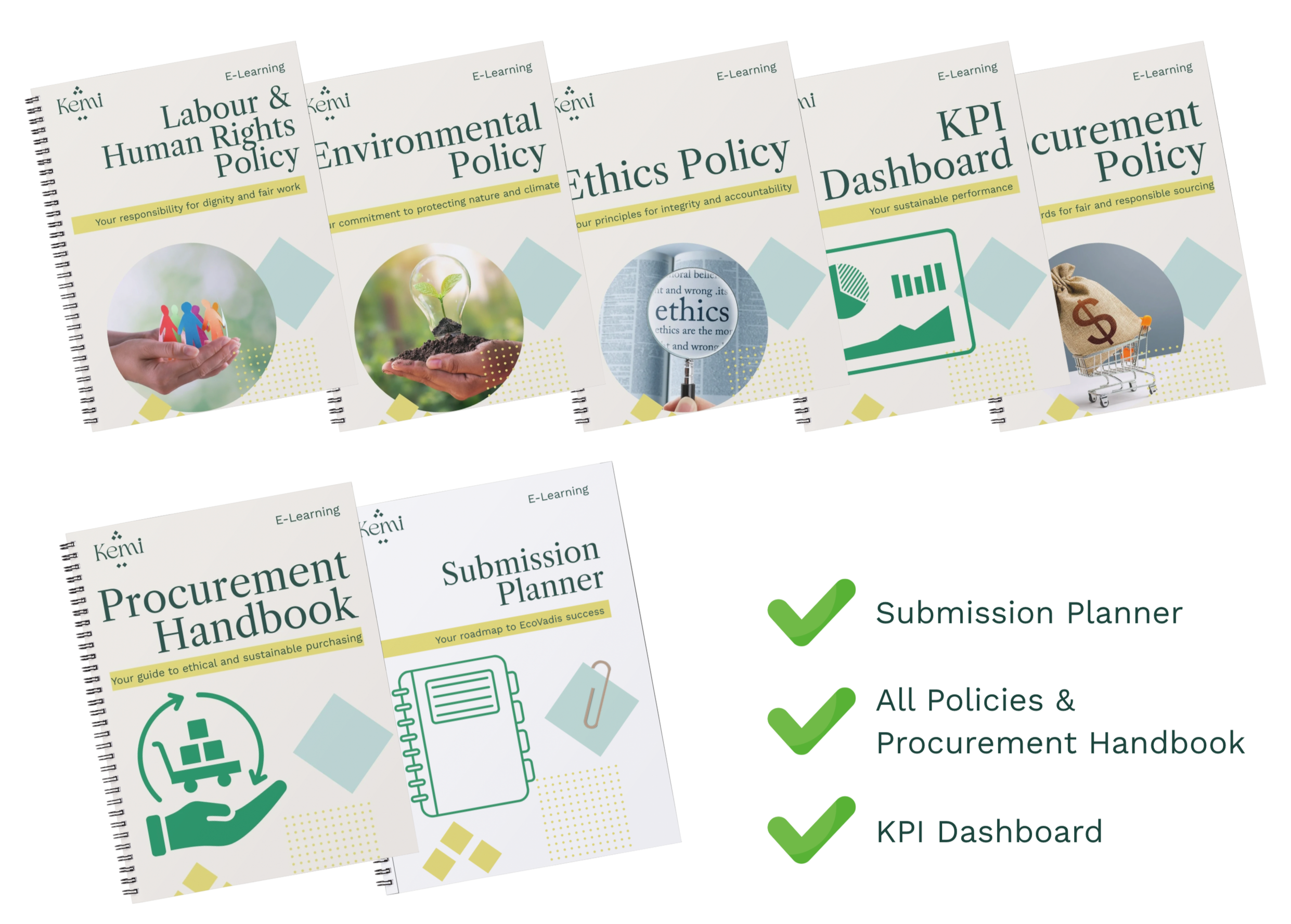
EcoVadis Templates Structured, submission ready policy templates, a KPI dashboard and a Procurement Handbook built specifically around EcoVadis requirements. Designed so your team can focus on evidencing, not drafting from scratch.
1:1 EcoVadis submission support Direct expert guidance from gap analysis to final submission review. I help you identify what matters, build the evidence that scores, and submit with confidence.
Common watch outs (and how to prevent them)
These are typical pitfalls. The fixes are simple.
The team uploads everything "just in case." Fix: Map every document to a specific question or theme. If it doesn't map, it doesn't upload.
Multiple versions of the same policy exist in the submission. Fix: One source of truth folder. Only final, approved versions get uploaded.
KPIs are spread across several files and formats. Fix: One KPI dashboard, structured around the four EcoVadis themes.
The sustainability report is not treated as main evidence. Fix: A strong sustainability report is one of the most valuable documents in your submission. It can carry quantitative targets, progress data and contextual information that no policy or KPI dashboard can fully capture. Treat it accordingly.
Evidence is collected in the final two weeks before submission. Fix: Build your evidence library throughout the year. By submission time, you should be curating, not scrambling.
The mindset shift that changes EcoVadis scores
The companies that consistently achieve Gold and Platinum have something in common. They don't ask "what else can we upload?" They ask "does every document in this submission earn its place?"
That moves the process from a reactive document collection exercise to a strategic evidence architecture. And it changes not just the score, but the amount of time your team spends on the submission.
I've helped companies reduce their evidence library by half while increasing their score by two medal levels. The work didn't change. The structure did.
If your current approach is "upload everything and hope," it might be time to rethink the strategy. The score you're leaving on the table probably isn't about missing evidence. It's about missing structure.
FAQ
How many documents should I upload for EcoVadis? EcoVadis has a 55 document limit per submission. But in my experience, 15 to 20 well structured documents consistently outperform submissions that try to max out the limit. Quality and relevance matter more than volume. The 55 limit is a ceiling, not a target.
Can I score Platinum with fewer than 20 documents? Yes. I've seen it happen. What matters is that every document clearly evidences a policy, measure, KPI or coverage point. Platinum is about system maturity, not file count.
Should I upload my full sustainability report? Yes, in most cases your sustainability report is one of your strongest pieces of evidence. It can hold quantitative targets that don't fit into a policy, present multi year progress data, and give context to your measures and KPIs. A well structured sustainability report often carries more weight than a KPI dashboard on its own, because it tells the full story behind the numbers.
What if I'm unsure whether a document is relevant? Ask yourself: which specific EcoVadis question or criterion does this file answer? If you can't identify one, it probably doesn't belong in the submission.
How do I know if my policies are too generic? If your Environmental Policy could belong to any company in any industry, it is too vague. EcoVadis rewards policies that reflect your specific context, risks and commitments. A policy that says everything says nothing.
What's the fastest way to improve a weak submission? Start with structure, not with more documents. Map your existing evidence to the four elements (Policy, Measures, KPIs, Coverage), identify the gaps, and fill those gaps with targeted, well structured documents.