
4 Structural Gaps That Keep Companies Stuck at EcoVadis Silver

Fundamentals
Score Improvements
Why your EcoVadis score isn't moving
You've submitted your EcoVadis assessment. Your team has done real sustainability work. You've uploaded evidence. And the result comes back: Silver. Again.
After supporting over 200 EcoVadis assessments across industries and continents, I can tell you that this is one of the most common situations I see. Companies doing solid work, but consistently scoring below what their efforts deserve.
The frustrating part is that the gap between Silver and Gold is rarely about dramatic change. It's almost never about doing more. It's about formalising what you already do in a way EcoVadis can recognise and reward.
By the end of this article, you'll understand:
the four structural gaps that keep most companies at Silver
why each gap costs you points even when your sustainability work is strong
what "structured formalisation" actually means in practice
how to turn each gap into a scoring opportunity
In 60 seconds: why Silver stalls
EcoVadis doesn't just assess whether you do sustainability work. It assesses whether your sustainability management system is mature. Maturity, in EcoVadis terms, means four elements are working together:
Policy A formal, specific commitment that reflects your organisation's context and risks.
Measures Concrete, documented actions that bring the policy to life.
KPIs Quantifiable indicators that track the impact of your measures, aligned with what EcoVadis assesses.
Coverage Evidence that all of the above applies across your entire organisation.
Most companies stuck at Silver have some of these elements in place. But almost all of them have at least one structural gap that prevents the score from moving. These gaps are remarkably consistent across industries, company sizes and geographies.
Gap 1: Policies exist, but are too generic
This is the most common gap I see. The company has policies. They cover the right topics. On paper, everything looks complete.
But when you read the actual documents, they could belong to any company in any industry. They use broad language like "we are committed to protecting the environment" or "we respect human rights in all our operations." There is no reference to specific risks, no defined responsibilities, no measurable commitments, no connection to the organisation's actual context.
EcoVadis assessors review hundreds thousands of submissions. They can spot a generic, template based policy immediately. And they score it accordingly.
What a high scoring policy looks like:
A strong EcoVadis policy does six things. It is aligned with the criteria EcoVadis activated for you in your risk profile. It defines a clear scope (who does it apply to, which sites, which subsidiaries). It assigns specific responsibilities (who owns implementation, who monitors, who reports). It includes measurable commitments (not "we aim to reduce emissions" but "we commit to reducing Scope 1 and 2 emissions by X% by 2028"). It references concrete measures (training programmes, audits, supplier assessments). And it includes a regular review mechanism that signals the policy is actively managed.
The fix: Review each of your four theme policies against these six criteria. If your Environmental Policy could belong to your competitor, it needs rewriting. The goal is a policy that could only belong to your organisation.
Gap 2: Measures are implemented, but not documented
This is the gap that causes the most frustration. The company is genuinely doing good sustainability work. They run training programmes. They conduct audits. They manage waste responsibly. They engage with suppliers on sustainability topics.
But none of it is formalised into structured management documents.
EcoVadis cannot score what it cannot see. A training programme that exists as an informal practice but has no documented structure, no attendance records, no defined schedule and no clear objectives will score significantly lower than one that is formalised, even if the informal version is excellent in practice.
This is not about bureaucracy. It's about demonstrating system maturity. EcoVadis needs to see that your measures are planned, executed, tracked and reviewed. That requires documentation.
What good documentation looks like:
A documented measure doesn't need to be a 30 page report. It needs to answer four questions clearly. What is the measure? Who is responsible? When and how often does it happen? How is it tracked or evaluated?
The fix: List every sustainability measure your organisation actively implements. For each one, check whether it exists as a formalised, documented programme or only as an informal practice. Prioritise formalising the measures that map directly to EcoVadis assessment criteria.
Gap 3: KPIs are tracked, but not aligned with EcoVadis
Many companies track sustainability data. They measure energy consumption, record workplace accidents, monitor waste volumes. The data exists.
But the KPIs are often structured around internal reporting needs or regulatory requirements rather than around the EcoVadis assessment framework. When your KPIs don't align with your specific EcoVadis risk profile, their scoring impact is limited. You might be tracking the right numbers, but presenting them in a way that doesn't connect to what the assessor is evaluating.
The right KPIs tell a story. They show that you understand your material risks, that you're measuring progress against them, and that the data covers your organisation comprehensively. The wrong KPIs are just numbers without context.
What aligned KPIs look like:
A strong KPI dashboard is structured around the four EcoVadis themes. Within each theme, the indicators reflect the specific risk profile EcoVadis assigns to your industry and geography. The data covers 36 months to show trends. And the dashboard is presented in a single, coherent document rather than scattered across multiple spreadsheets.
For example, a manufacturing company with a high environmental risk profile needs different KPIs than a professional services firm. EcoVadis knows this. Your KPI selection should reflect it.
The fix: Map your current KPIs against the four EcoVadis themes. For each theme, check whether your indicators match the risks EcoVadis highlights for your industry. Remove KPIs that don't serve the assessment. Add indicators where gaps exist. Consolidate everything into one structured dashboard.
Gap 4: Coverage is incomplete
This gap only affects companies with more than 1000 employees: EcoVadis evaluates the coverage of your policies, measures and certifications. If your ISO 14001 certification covers one factory but not the other three, EcoVadis scores it accordingly. If your training programme runs at headquarters but not at regional offices, the coverage is limited. If your Supplier Code of Conduct has been signed by 40% of your suppliers, that is a different score than 90%.
Many companies present strong evidence for one part of their organisation and assume it represents the whole. EcoVadis doesn't make that assumption. If coverage is not explicitly stated, the assessor will default to a conservative interpretation.
What full coverage looks like:
Every KPI should indicate whether it covers the full organisation or a subset. And every certification should be accompanied by a clear statement of which entities and sites are included.
This is often a documentation issue rather than an implementation issue. The company may well track its KPIs globally, but if there is no KPI overview with a site breakdown, the assessor cannot credit it.
The fix: Create a KPI dashboard mapping each KPI and certificate against all of your operational sites and offices coverage is partial, acknowledge it and indicate plans to extend. Where coverage is full, make sure the document says so clearly.
The pattern behind the pattern
These four gaps rarely exist in isolation. They reinforce each other.
A generic policy leads to vague measures. Vague measures produce misaligned KPIs. And without clear coverage statements, even strong evidence gets undervalued.
The reverse is also true. When you fix one gap, the others become easier to address. A specific, well structured policy naturally points to the measures that should support it. Those measures define the KPIs that should track them. And clear coverage statements tie everything together.
That's why I describe the difference between Silver and Gold as structured formalisation. The underlying sustainability work is often already there. What's missing is the structure that makes it visible, scorable and repeatable.
How to turn these gaps into an EcoVadis scoring strategy
If you recognise one or more of these gaps in your own submission, here is a practical approach to closing them.
Start with policies
Policies are the foundation. If they are generic, everything built on top of them inherits that weakness. Rewrite your four theme policies to include clear scope, defined responsibilities, measurable commitments, references to concrete measures and a review mechanism. This single step often has the highest scoring impact of any improvement you can make.
Formalise your top measures
You don't need to document every initiative. Focus on the measures that map directly to EcoVadis assessment criteria and that demonstrate the strongest link between policy commitment and practical action. A small number of well documented measures is more valuable than a long list of informal activities.
Restructure your KPIs
Build or rebuild your KPI dashboard around the four EcoVadis themes and your specific risk profile. Include multi year data where available. Present everything in one document. Make the connection between each KPI and the measure it tracks explicit.
Add coverage statements everywhere
Go through every document in your submission and check for explicit scope and coverage information. This is often the quickest fix and one of the most impactful. A single sentence confirming that a policy applies to all sites globally can change how the entire document is scored.
When companies understand this, frustration turns into strategy
The most rewarding part of my work is the moment when a company stuck at Silver realises that the gap isn't about effort. It's about structure.
That realisation changes everything. Instead of asking "what more can we do?" the team starts asking "how do we present what we already do in a way EcoVadis can score?" The frustration lifts. The path forward becomes clear. And the next submission feels like a strategic exercise rather than a scramble.
The difference between Silver and Gold is rarely dramatic change. It is structured formalisation. And once you see it, you can't unsee it.
How Kemi can help
I offer two paths for companies ready to close these gaps.
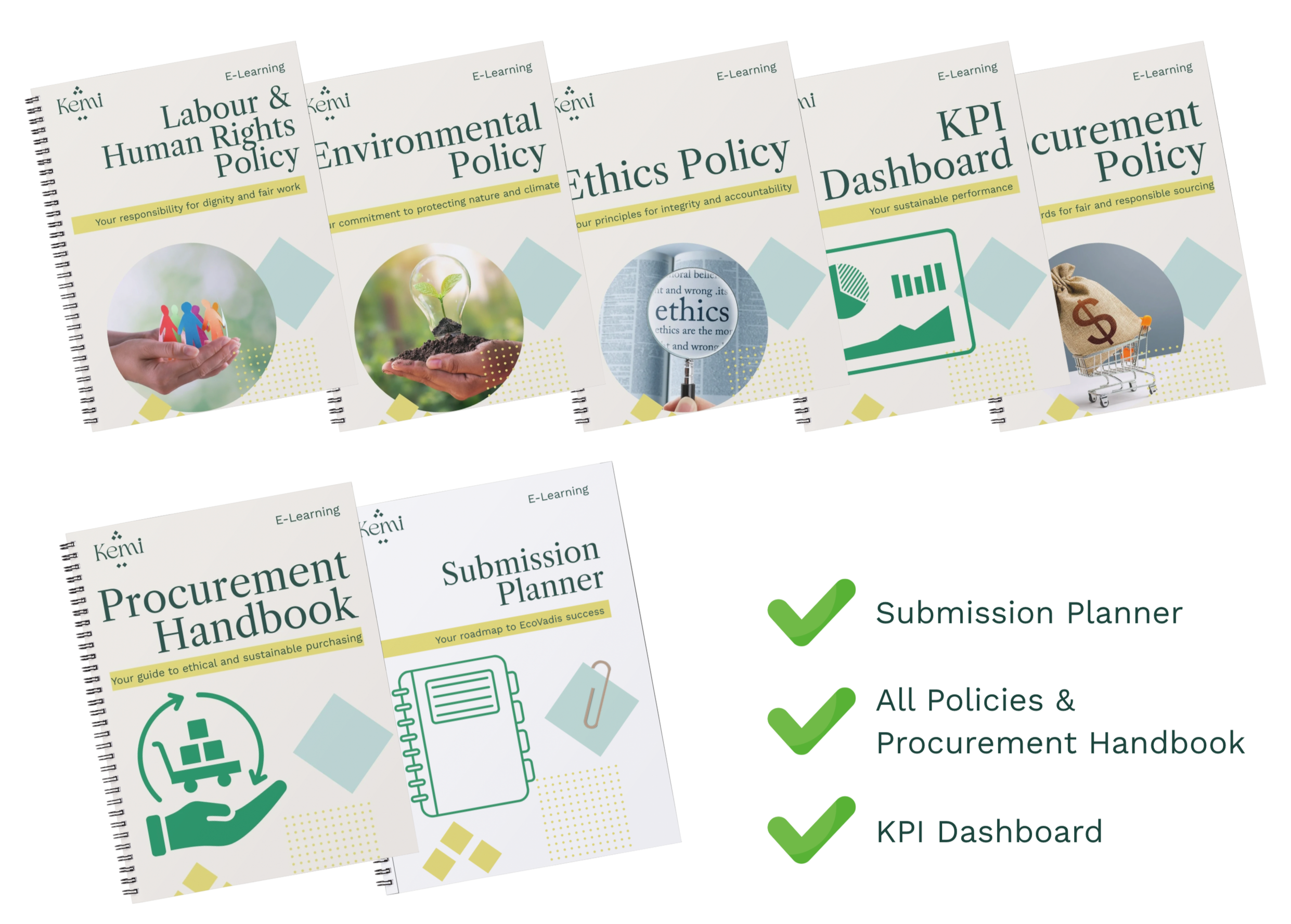
EcoVadis Templates Structured, submission ready policy templates, a KPI dashboard and a Procurement Handbook built specifically around EcoVadis requirements. Each template addresses the gaps described in this article by design, so your team starts with structure rather than a blank page.
1:1 EcoVadis submission support Direct expert guidance from gap analysis to final submission review. I help you identify which of these four gaps is holding your score back, build the evidence that closes them, and submit with confidence.
FAQ
Why is my EcoVadis score stuck at Silver? In most cases, the issue is not a lack of sustainability effort. It is one or more structural gaps in how that effort is documented and presented. The four most common gaps are generic policies, undocumented measures, misaligned KPIs and incomplete coverage.
What is the difference between Silver and Gold on EcoVadis? The threshold changes slightly each year as EcoVadis recalibrates. But the qualitative difference is consistent: Gold submissions demonstrate a mature, formalised sustainability management system. Silver submissions typically show real work with structural gaps in documentation or alignment.
Can I move from Silver to Gold in one assessment cycle? Yes. I've helped companies do this many times. The key is identifying the specific gaps in your current submission and closing them with targeted, well structured evidence. It doesn't require a complete overhaul. It requires focus.
Do I need certifications like ISO 14001 to reach Gold? Certifications can support your score, but they are not required. A company with strong, tailored policies, well documented measures and aligned KPIs can reach Gold without any certifications. Conversely, a certification with limited coverage won't compensate for generic policies.
How do I know if my policies are too generic? Apply this test: could your policy belong to a completely different company in a completely different industry? If the answer is yes, the policy lacks the specificity EcoVadis rewards. Strong policies reflect your organisation's specific context, risks, responsibilities and commitments.
What does "structured formalisation" mean in practice? It means taking sustainability activities that your organisation already performs and documenting them in a way that demonstrates maturity: clear ownership, defined processes, measurable targets, tracked progress and stated coverage. The work doesn't change. The structure around it does.