
EcoVadis submission ownership: roles, responsibilities and cadence

Fundamentals | A2
EcoVadis submission ownership
EcoVadis submissions move fast when one thing is clear: who owns what.
This guide helps you set up a simple ownership structure so your submission feels coordinated, not chaotic. It works for a one-person submission in a small company and for cross-functional teams in larger organisations.
By the end, you’ll have:
a practical role map you can use immediately
a lightweight cadence that keeps progress steady
a simple way to prevent bottlenecks and last-minute scrambling
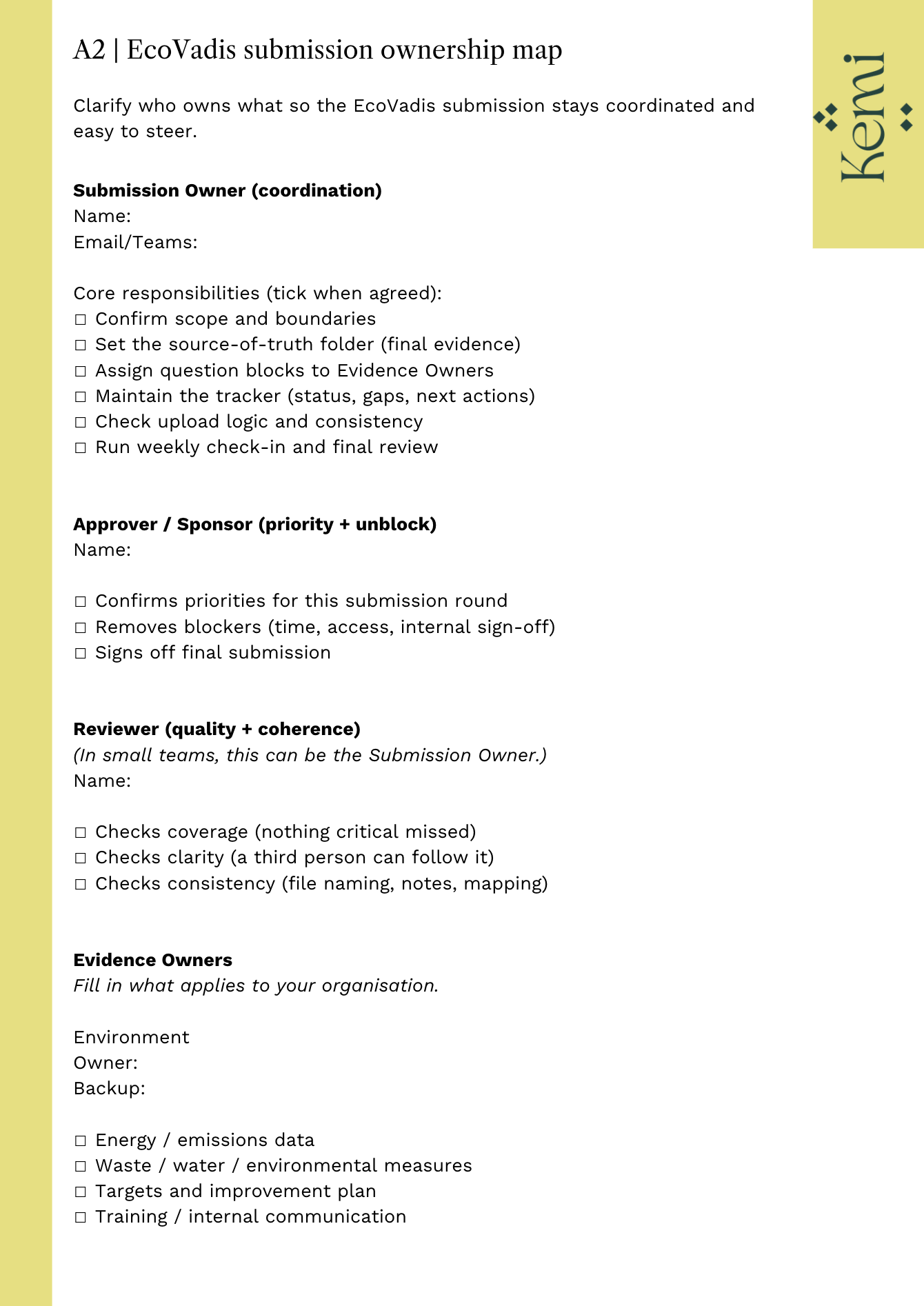
At the end of this article, you can download a free printable ownership map to file in your EcoVadis folder.
In 60 seconds: the ownership model
A reliable EcoVadis setup usually includes four roles:
Submission Owner
Keeps the submission on track. One person. One point of coordination.
Evidence Owners
Provide evidence for their area (HR, H&S, Environment, Procurement, Compliance, etc.).
Reviewer
Checks completeness and consistency before submission (often the same as Owner in small teams).
Approver
Signs off, confirms priorities and removes blockers (management sponsor).
You can combine roles in small teams. The key is that the Submission Owner is explicit.
Why ownership matters (more than tools)
EcoVadis is a structured assessment. Even when your sustainability work is strong, you still need coordination to demonstrate it clearly.
Without defined ownership, three things tend to happen:
evidence lives in multiple places, and no one knows which version is final
questions get forwarded around, and decisions stall
the submission becomes a last-minute compilation instead of a steerable process
Clear roles fix this. They make the submission predictable and easier to manage.
Step 1: Appoint a Submission Owner
What the Submission Owner does: The Submission Owner is the coordinator, not the person who “does everything”.
What good looks like
everyone knows who to ask for status
decisions do not drift
the submission has one coherent structure
Tip: In most companies, the best Submission Owner is the person closest to procurement, sustainability, quality, or compliance—someone who can coordinate across departments.
Core responsibilities:
defines scope with internal stakeholders
sets the folder structure (source of truth)
assigns questions to Evidence Owners
keeps a simple tracking overview (even a spreadsheet is enough)
reviews uploads for logic and consistency
Step 2: Define Evidence Owners by topic
Evidence Owners are people who can provide documents, data, and proof for a specific area.
Typical EcoVadis-aligned areas:
Environment (energy, emissions, waste, water, targets, training)
Labour & Human Rights (HR policies, working conditions, H&S, training)
Ethics (anti-corruption, whistleblowing, compliance, data privacy)
Sustainable Procurement (supplier onboarding, code of conduct, monitoring)
What Evidence Owners do
provide relevant documents and data (not everything, only what fits the questionnaire)
answer clarifying questions about how things work in practice
confirm what is current and what is outdated
review draft notes or mappings when needed
What good looks like
Each Evidence Owner can respond to two prompts:
“What proof do we have that matches these questions?”
“What would a reviewer need to understand this evidence quickly?”
Step 3: Assign a Reviewer and an Approver
Upload logic means your submission has a consistent structure. A reviewer can quickly understand what each file is for.
The Reviewer role
A good review is less about perfection and more about consistency.
The Reviewer checks:
coverage across questions (nothing critical missed)
upload logic (files match questions, notes make sense)
clarity (a third person can follow the submission)
In smaller teams, the Submission Owner often acts as Reviewer. In larger teams, a second set of eyes is valuable.
The Approver role
The Approver is a sponsor who:
confirms priorities (what matters most for this round)
removes blockers (time, access, internal approvals)
supports the cadence
This role prevents the submission from getting stuck between departments.
Step 4: Set a cadence that keeps momentum
You do not need heavy project management. You need a steady rhythm. A practical cadence looks like this:
Weekly (20–30 minutes)
Submission Owner reviews progress
Evidence Owners confirm what’s coming next
One priority for the week is agreed (not ten)
Midway checkpoint (15 minutes)
sanity check: scope still correct
evidence quality check: relevance, credibility, recency
identify gaps early
Final week (60–90 minutes)
review submission end-to-end
confirm upload logic and coverage
final approvals and submission
Setting this up from scratch is the hardest part. If you'd rather not figure out the ownership map alone, this is what I help with in 1:1 EcoVadis submission support.
Two setups that work
Setup A: Small company (1–3 people involved)
Submission Owner: 1 person (often operations, quality, or sustainability lead)
Evidence Owners: 1–2 people for HR/H&S and Environment (sometimes combined)
Reviewer: same as Submission Owner (or consultant!)
Approver: managing director or owner
This setup works when the workflow is simple and evidence is centralised.
Setup B: Cross-functional team (4–10 people involved)
Submission Owner: sustainability/compliance/procurement coordinator
Evidence Owners: HR, H&S, Environment, Procurement, Compliance
Reviewer: second person (quality/compliance) for consistency (or consultant!)
Approver: senior sponsor (CFO/COO/Head of Procurement)
This setup works when ownership is explicit and the cadence is lightweight.
Common watch-outs (and how to prevent them)
These are typical bottlenecks. The fixes are simple.
Everyone is “supporting”, no one is owning.
Fix: Name one Submission Owner.
Evidence arrives late because it is not prioritised internally.
Fix: Appoint an Approver who can unblock and set priority.
Files are sent by email and stored in multiple places.
Fix: One source-of-truth folder.
The team collects documents without mapping to questions.
Fix: Evidence Owners work from assigned question sets.
Review happens only at the end.
Fix: Midway checkpoint for gaps and consistency.
Free download: printable workflow checklist
If you want this workflow as a interactive tool, download the printable checklist here.
How to use it
Download the PDF and print it (A4)
File it as the first page in your EcoVadis folder
Use it as your weekly checkpoint while preparing or running your submission
FAQ
Who should own the EcoVadis submission?
One person should coordinate it. The best owner is usually someone who can work across teams and keep structure: procurement, sustainability, compliance, quality, or operations.
Can one person do everything?
In a small company, yes. The important part is still to separate “coordination” (owner) from “evidence sources” (who provides what), even if it’s the same person wearing two hats.
How many Evidence Owners do we need?
As many as needed to cover the four EcoVadis themes. In small teams, one person can cover multiple areas.
What does “Approver” mean in practice?
Someone who can confirm priorities and remove blockers: time, access, internal sign-off. This prevents delays.
How do we keep it lightweight?
Use one simple tracker (spreadsheet), one folder structure, and one weekly check-in. That is enough for most teams.
What if we are mid-submission and ownership is unclear?
Start today: name the Submission Owner and assign the remaining questions in blocks. Even a simple ownership reset creates momentum quickly.
Read next
To build on this structure, these guides help most:
EcoVadis submission workflow: scope, evidence and upload logic
Document types: policy vs procedure vs results evidence
Evidence recency: choosing the right time horizon for uploads